
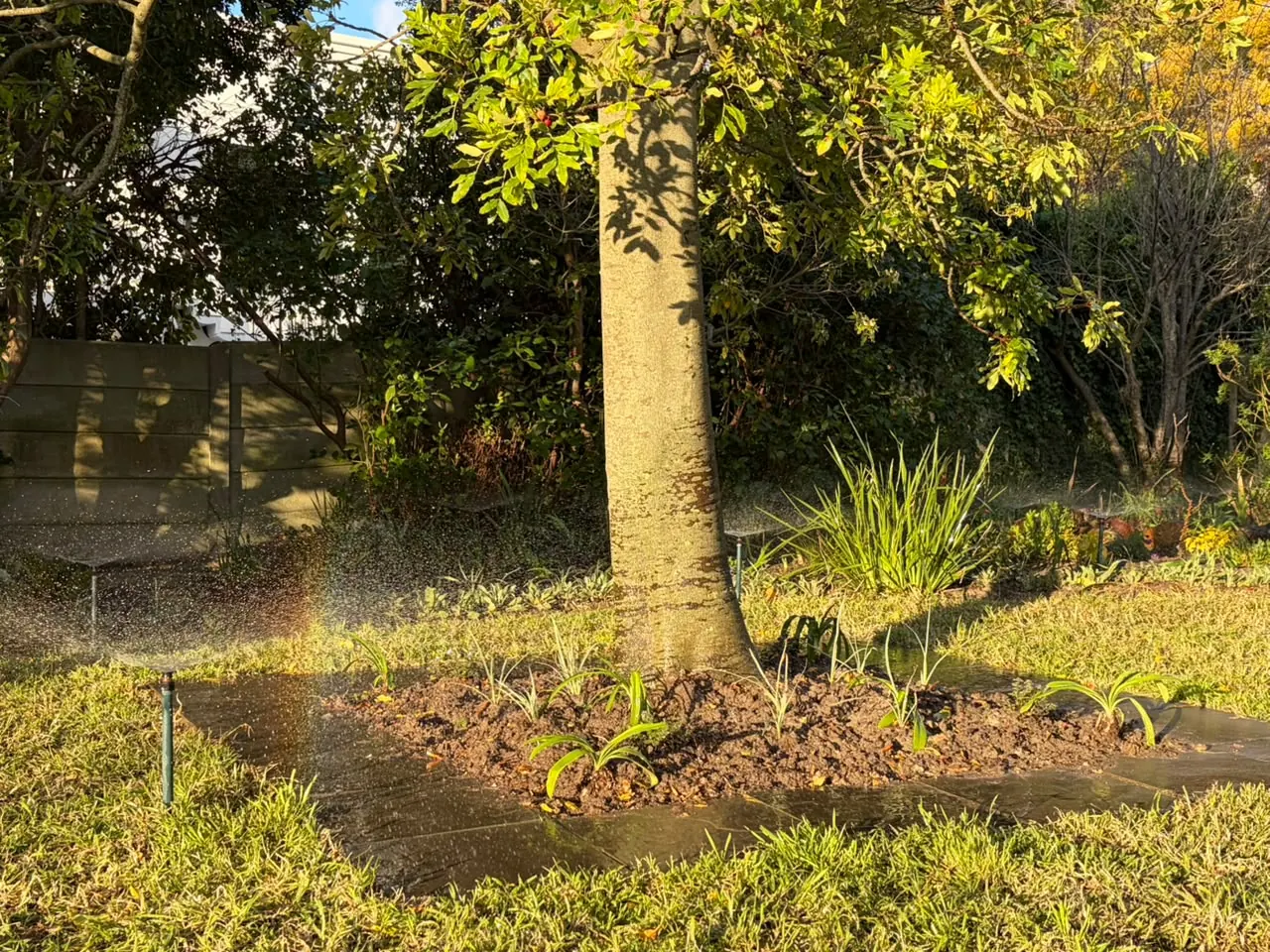
Say "water-wise" to most people and they picture a front yard of white gravel, three aloes and a sad succulent in a pot. That's not what we build, and it's not what water-wise actually means. A well-designed water-wise garden can be lush, layered and full of colour through most of the year — it just directs water where it earns its keep and refuses to waste it where it doesn't. We've put this into practice on everything from small Stellenbosch townhouse gardens to multi-acre estate grounds, and the same handful of principles hold at every scale.
Here's what we actually build into every design, and why each piece matters.
1. Plan around water zones
Group plants by how much water they need. Thirsty plants go near the house or entertainment area where you'll enjoy them most — this is also usually where runoff from roofs and paving naturally collects, so you're working with the site rather than against it. Hardy, drought-tolerant plants go further out, near boundaries and in spots you walk past rather than linger in. Each zone then gets the irrigation it actually needs, instead of the whole garden being watered on one blanket schedule, which is how most home gardens waste water without anyone noticing.
A practical example: a typical Stellenbosch townhouse garden might have a small patch of lawn and a few pots on the patio, a main bed along the boundary wall, and a dry corner behind the garage. That's three zones with three different needs. The lawn and pots get regular water, the boundary bed gets a drip line on its own valve, and the dry corner gets drought-tolerant planting that is watered by hand through its first summer and then largely left alone.
2. Improve the soil first
Soil that holds moisture is the cheapest water saving there is, and it's the step people skip because it's invisible once the garden is finished. Compost and organic matter dug into sandy, Cape Flats-type soil help it hold onto water instead of letting it drain straight through. In heavier clay soils, closer to what you find in parts of Paarl, the same organic matter improves drainage so roots don't sit waterlogged through winter and rot. Get this step right and everything you plant afterwards performs better with less input from you.
3. Mulch every bed
A layer of mulch about 5 to 8 cm deep keeps the soil cooler, slows evaporation and suppresses weeds that would otherwise compete with your plants for every drop. It's the single most effective, least glamorous thing you can do for a summer garden — and one of the easiest things to let slip, since mulch breaks down and needs topping up. We generally recommend checking it at the start of spring and again mid-summer if the beds are looking thin.
Coarse, chunky mulch such as bark or wood chips stays put in the Cape's south-easter wind, while very fine material tends to blow away. Keep it a few centimetres clear of stems and trunks so the base of the plant can breathe, and don't pile it up in a volcano around trees.
4. Choose plants that suit the climate
Indigenous and Mediterranean-climate plants have already adapted to dry summers. Restios, wild rosemary, agapanthus, olive trees and succulents are good starting points. We cover our favourites in our guide to indigenous plants for Winelands gardens.
5. Water deeply and early
Deep, less frequent watering encourages roots to grow down, which makes plants tougher in summer heat. Water in the early morning, when evaporation and wind are lowest. Midday watering wastes a lot of water.
A simple check: push a screwdriver or a spade into the soil an hour after watering. If it slides in easily to a depth of 15 to 20 cm, you've watered deeply enough. If the soil is dry just below the surface, you're giving the plant a sip rather than a drink. New plantings are the exception. They have small root systems and need more frequent watering for their first season, tapering off as they establish.
6. Use efficient irrigation
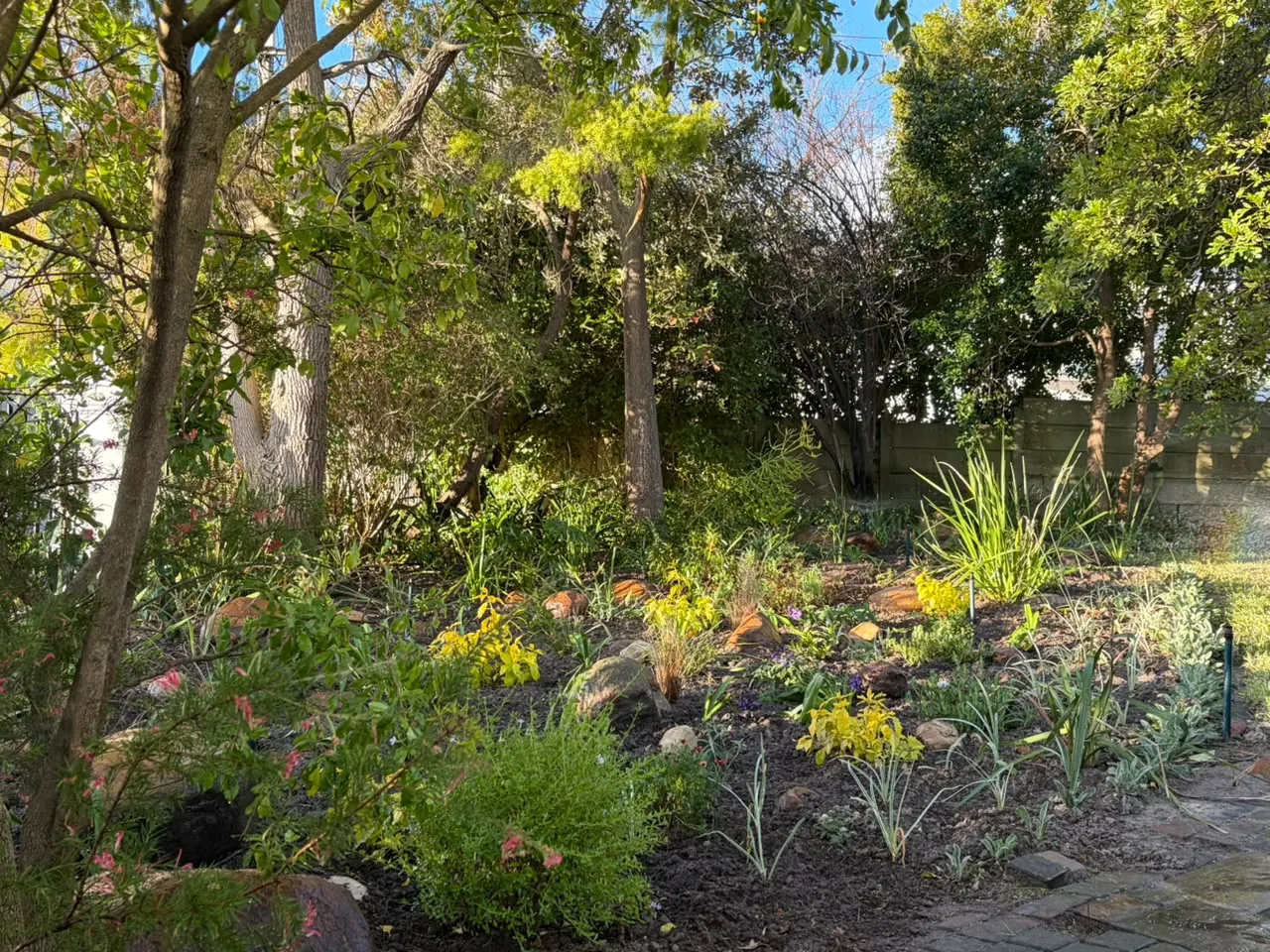
Drip irrigation delivers water straight to the roots, and a timer or controller takes the guesswork out. Add a rain sensor and the system stops watering when it doesn't need to. Read our comparison of drip vs sprinkler irrigation to see which fits different parts of your garden.
A drip system is only as good as its upkeep. Emitters block, pipes get pulled loose, and a controller left on a summer schedule through autumn keeps watering when the rain has already done the job. Walk each zone and watch it run at the start of spring (we cover this in our summer-ready checklist) and adjust the schedule with the seasons.
7. Reduce the lawn
Lawn is usually the thirstiest part of a garden. You don't have to remove it entirely. Keep a smaller area for where it's actually used and replace the rest with ground covers, planting beds or paving.
If you keep a lawn, mow it a little higher in summer. Taller grass shades its own roots and copes with heat far better than a closely scalped lawn. Give it a clean, defined edge so it's obvious where the lawn stops and the beds begin, and so you're not watering garden beds by accident.
8. Collect rainwater
Winter rain in the Western Cape is generous. Tanks connected to your gutters let you store some of it for the dry months.
A tank doesn't have to be an eyesore. Slimline tanks sit flat against a wall, and larger ones can be screened with planting or a timber slat screen. Make sure the overflow runs somewhere useful, such as a planting bed or soakaway, rather than straight onto paving, and use the stored water for hand watering and the thirstier beds.
9. Let hard surfaces work for you
Paving and driveways shed water, and all of that runoff ends up in the stormwater drain instead of your garden. Gravel paths, permeable paving and stepping stones set into planting let rain soak in where it lands. On sloping sites, a retaining wall or gabion wall slows water down and gives it time to sink in rather than rushing off the property. We look at the practical side of that in our guide to gabion walls: cost, look and lifespan.
How a water-wise garden changes through the year
Winter is when the garden looks after itself: let the rain do the work, switch the irrigation controller right down, and use the quiet months to plan changes. Spring is the maintenance window. Top up the mulch, test every irrigation zone and tidy the beds. Summer is about discipline, with early-morning deep watering and no more than the plants really need. Autumn is the best time to plant anything new, because the soil is warm and the rains are on their way. Our month-by-month planting guide maps that out in detail.
Mistakes we see again and again
- Ripping everything out for gravel. Bare gravel gets hot, supports nothing and still needs weeding. A planted bed with mulch is cooler, greener and uses very little water once established.
- Mixing thirsty and tough plants on the same line. One of them always loses. Either the thirsty plant is starved or the hardy one is drowned.
- Installing drip and never checking it. A blocked emitter can mean a dead plant that nobody notices until it's too late.
- Planting in mid-summer. New plants are the thirstiest plants in the garden. Plant in autumn and let the winter rain help.
- Skipping the soil. It's the least visible step and the one that pays back the longest.
Where to start if you can't do it all at once
You don't need to redo the whole garden in one go. Start with the cheapest, highest-return jobs: mulch every bed, then get your irrigation zoned properly so thirsty and tough plants aren't on the same line. After that, replace the worst offenders one bed at a time, and shrink the lawn when you're ready. If you want a sense of what a phased project costs, our guide to landscaping costs in Stellenbosch and Franschhoek breaks it down. On larger estate and guesthouse grounds, the same phased approach works well, and we look at it in landscaping for wine estates and guesthouses.
Water restrictions can change, so check your municipality's current rules before planning irrigation.
Ready to stop guessing and start saving water? We design and install water-wise gardens as part of our landscaping design service across the Winelands, whether that's a new garden or a phased retrofit of what you already have. Book a free site visit on 071 719 1285.
Common Questions
More Guides
 Guide
 Guide